
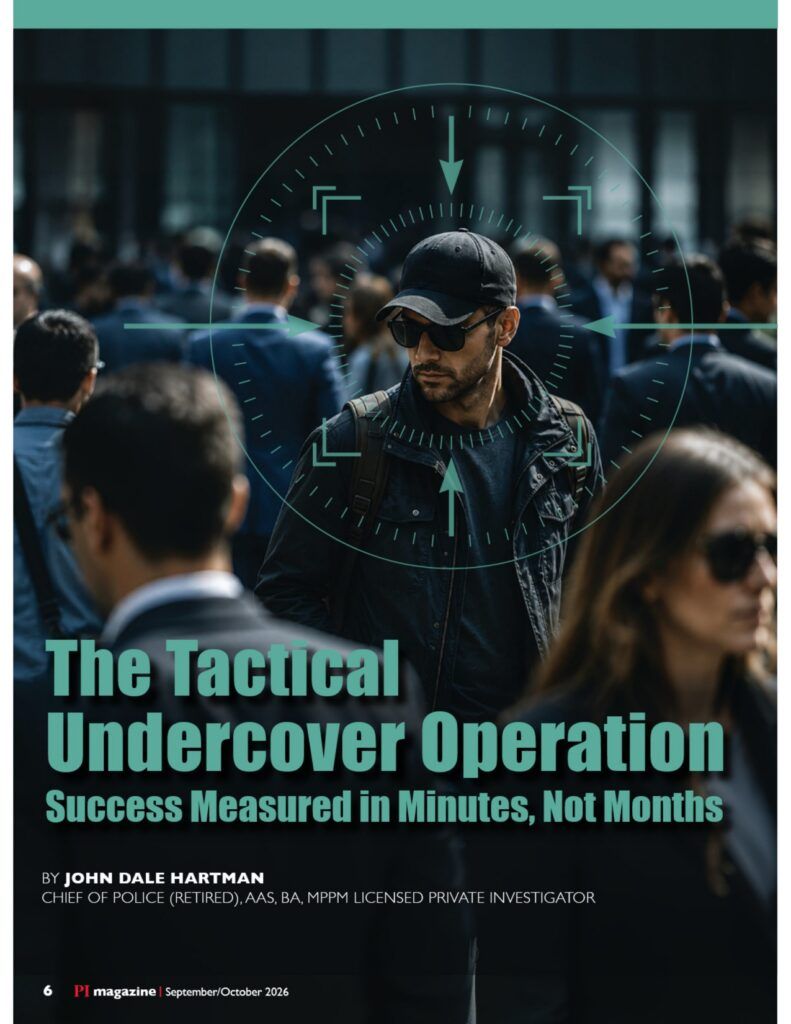
When people hear the words undercover operation, they immediately think of images created by television and Hollywood. They see investigators. spending years infiltrating organized crime families and the like. While these portrayals may be true, they create misconceptions surrounding a vast majority of undercover operations. That misconception often finds its way into our profession as well.
Many investigators enter the private sector believing that successful undercover work is measured by the length of time an investigator remains embedded within a targeted environment. They envision complex legends, carefully developed backstops, elaborate disguises, operational overwatch, and months of carefully choreographed relationships. While those techniques certainly have a place in investigations, they represent a small fraction of the undercover work commonly performed by private sector practitioners.
Most private investigators who conduct undercover assignments are not attempting to dismantle criminal organizations. Rather, they are retained by attorneys, insurance companies, corporations, or private clients to answer very specific questions on equally specific issues. Is a workers comp recipient secretly working in a particular establishment? Was alcohol served to an obviously intoxicated patron? Were safety procedures being followed? Was an area adequately maintained? Were employees complying with company policy? What did the premises look like on a particular day? How did employees interact with customers? Was a particular condition present or absent?
These questions seldom require weeks of covert interaction but rather fall into the category of tactical undercover operations. By definition, a tactical undercover operation can be described as a carefully planned, limited-duration investigation where an investigator assumes a temporary role or identity to obtain information or evidence that cannot reasonably be acquired through overt investigative methods. All while minimizing exposure, legal risk, and operational complexity.
The distinction I am making between more complex gov- ernmental operations and the private sector tactical undercover operation is more than mere semantics. It is the product of an entirely different philosophy. Tactical operations are objective- driven rather than duration-driven. They are conducted for a clearly defined and often limited purpose, under controlled conditions, with the understanding that every additional minute spent inside the target increases both exposure and risk. Simply stated, the mission is to get in, get the intelligence, and get out without contaminating the effort.
SCOPE OF ASSIGNMENT AND PREPARATION
Although every private sector assignment presents unique challenges, they all share a central characteristic. Success is seldom achieved as a result of the agent remaining undercover for an extended period of time. The success of the operation is more often tied to careful planning before the agent enters the target area.
As both an investigator and an administrator in both the public and private sectors, I learned that investigators frequently fail because they begin by concentrating on what they are going to wear, what they are going to say, or what equipment they intend to carry. The true starting point is establishing a clearly defined investigative objective. Every undercover operation should begin with a single question: What am I attempting to accomplish? Put in another way, what is the precise objective of the mission?
This may sound simple, but this fundamental question is often overlooked. If the objective is to determine whether visibly intoxicated patrons continue to be served alcohol, then everything about the operation should support that objective. If the assignment involves documenting the physical condition of a restaurant following a reported slip-and-fall incident, then the investigation should focus on documenting those conditions. This principle is often missed. Ancillary curiosity about unrelated matters may result in mission failure. Now, to be clear, attention to matters not immediately apparent at the outset may lead to additional avenues of inquiry. However, ensure your primary objectives are achieved before embarking on “fishing expeditions.” Ask yourself, does this “newfound” intelligence really matter? Does it drive the investigation towards the defined objectives? Will it support your case?
Investigators often confuse activity with productivity. They believe that collecting additional information automatically benefits the client. In reality, gathering information beyond the scope of the assignment often creates unnecessary risk while adding little evidentiary value. Every conversation initiated without purpose, every unnecessary photograph, every extra minute spent lingering inside a business creates another opportunity for you to compromise your cover.
PLANNING
Your undercover operation should commence with planning. Planning begins long before the investigator arrives at the target location. Today, we have resources that earlier generations could never have imagined. Satellite imagery, online mapping applications, business websites, customer reviews, social media accounts, public records, photographs, and even promotional videos frequently provide valuable intelligence regarding the environment or person under investigation. Appropriate intelligence gathering may reveal a multitude of factors to be considered including customer traffic patterns, parking arrangements, entrances and exits, hours of operation, seating configurations, security cameras, lighting conditions, and others. The investigator who arrives already familiar with the environment can only be expected to be more comfortable and confident. Confidence reinforces natural behavior, critical to the successful operation.
This preliminary research should likewise include a careful legal analysis of the assignment. Every jurisdiction presents unique issues involving recording laws, expectations of privacy, photography, trespass, consent, and evidence collection. The investigator’s responsibility is not merely to gather evidence but to gather evidence lawfully. A superbly executed operation that produces inadmissible evidence accomplishes little and very likely may result in civil and criminal liability.
DEVELOPING THE LEGEND
The next phase of these investigations should be developing what law enforcement traditionally refers to as the legend. It is important to understand that private-sector investigations differ significantly from the deep-cover governmental operations. The greatest mistake investigators make is believing that every undercover assignment requires an elaborate fictitious identity. It does not. In fact, complexity may actually adversely impact on credibility.
If your assignment requires you to visit a restaurant, your legend may simply be that of a customer seeking dinner. If you are documenting conditions inside a commercial establishment, you may be nothing more than an ordinary customer. If your assignment involves evaluating customer service at a business, then behaving as a customer may be all that is necessary. The most formidable legends are often the simplest requiring the least maintenance. Every unnecessary detail introduces another opportunity for inconsistency. Investigators should never create more than the assignment requires. The objective is to provide a believable reason for being present, asking questions and interacting with those in the target location.
Appearance is likewise important. Contrary to popular belief, undercover investigators do not normally benefit from looking unusual. In most assignments, the investigator should simply appear appropriate for the environment. Clothing should reflect the clientele. A business casual appearance may be appropriate for one assignment, while jeans and a polo shirt more suitable for another. Do not attempt to “look undercover,” whatever that may mean. Blending into the environment is more effective than attempting to disguise oneself. The objective is to be physically present, yet so consistent with the surrounding environment that your presence attracts no attention or suspicion. In short, “Hide in plain sight.”
Equipment selection follows these same rules. There is a lot of “wiz bang stuff” out there. Carry only that which the mission requires. Modern technology has dramatically reduced the size of investigative equipment, allowing investigators to document effectively and discreetly. Even so, every piece of equipment should serve a specific purpose. Excessive gear complicates the operation, increases the likelihood of detection and creates the possibility of more going wrong. Murphy’s law has taught all of us that “Anything that can go wrong will go wrong.”
BELIEVE THE LEGEND BEFORE ANYONE ELSE DOES
Over the years, I have had the privilege of knowing and working with people from many different professions. One conversation that has stayed with me did not come from another investigator, but from a friend who is a professional actor. Actors’ stock-in-trade is playing another person. Capitalizing on this skill set, I presented him with a somewhat simple question. I asked what is critical to assuming another identity. His advice was simple but profound, “Believe you are who you say you are. If you don’t believe the character, neither will your audience.”
At first glance, this may sound like advice reserved for the screen. The more I thought about it, however, the more I realized the same principle applies to undercover investigations. An investigator who is uncertain about his or her own legend often reveals that uncertainty in ways he or she may fail to recognize. Pitfalls include hesitation before answering a simple question, providing an explanation that sounds rehearsed, unnatural eye contact, or a voice that changes pitch when challenged. These small inconsistencies, standing alone, may not mean much but together may suggest to your target that something is not quite right.
Contrary to popular belief, people are remarkably perceptive. Most cannot explain why someone makes them uncomfortable, but they instinctively recognize behavior that seems unnatural. You should therefore understand that a legend must be more than a memorized cover story. It must become your temporary reality. To be clear, I did not say your permanent reality. I am not suggesting that you lose yourself in elaborate role-playing. The objective is not a theatrical performance but rather simple authenticity necessary to pull off a particular operation.
If your legend is that you are a customer looking for a place to have lunch, then for the duration of the operation, that is exactly what you are. If your assignment is to visit a commercial establishment as a prospective customer, then your thoughts, questions, and behavior should originate there. You should not be thinking like an investigator pretending to be a customer. You should simply think like a customer. When investigators continually remind themselves, “I’m undercover,” they may become overly self-conscious. They begin monitoring every movement, every word, every facial expression. This heightened sensitivity can produce the exact behavior they are trying to avoid. Simply accept your reason for being there, believe it, and run with it.
Before commencing an assignment, it may likewise help to visualize the encounter. Visualize yourself entering the location, ordering your meal or asking your questions. Consider the conversations that are likely to occur and how an ordinary customer may respond. By mentally preparing for the interaction before it happens, you reduce creating challenges to your cover.
Be clear, investigators who lack confidence in their cover often compensate by talking too much. They volunteer unnecessary information, expand upon answers no one requested, or attempt to convince others on the reason they are there. The fact remains: credibility is seldom established through lengthy explanations. Credibility is established through natural behavior. Most people do not challenge someone who appears comfortable. They question the person who appears to be trying too hard to fit in. Again, before you expect anyone else to believe your legend, be sure you believe it yourself.
WORKING THE COVER
The operation itself should unfold naturally. One characteristic of successful investigators is their ability to observe inconspicuously. This skill cannot be overstated. The investigator will often be required to notice lighting conditions, surveillance camera placement, emergency exits, housekeeping practices, employee interactions, patron behavior, warning signs, security procedures, floor conditions, visibility, and dozens of subtle details that may later become critically important. Despite making these observations, the actions of the investigator must not be obvious. People become suspicious when someone behaves differently. They rarely notice someone behaving
normally.
Photography requires similar restraint. Today’s society has become increasingly accustomed to customers using mobile phones. Consequently, discreet photography has become far easier. With that said, every photograph should have a purpose. Random images consume time, attract attention, and may actually produce little evidentiary value. Always remember, in the end, quality outweighs quantity. One well-composed photograph documenting a condition is far more valuable than fifty images that contribute little to the investigation.
MISSION CREEP
One of the more insidious operational threats confronting tactical undercover investigators is the concept of mission creep. Mission creep occurs when investigators continue exploring simply because opportunities present themselves. The original assignment is complete. The necessary photographs have been obtained. The required observations have been made. Yet instead of leaving, curiosity takes over. The investigator decides to “look around a little longer.” Maybe another conversation will produce additional information. Occasionally it certainly does. In many instances, however, the risk of increased exposure outweighs any potential benefit. Simply put, learn to recognize when the objective has been achieved and conclude the operation.
Dovetailing on that, leaving a target environment should appear routine. The investigator pays the bill, thanks the staff if appropriate, exits naturally, returns to the vehicle, and departs. There should be no lingering in the parking lot reviewing photographs, making telephone calls within view of the business, or unnecessarily re- entering the location. An operation is not complete until the investigator has successfully disengaged. In short, don’t “lollygag around,” get out.
DOCUMENTATION
After leaving the environment, your attention should immediately move toward documentation. This is what distinguishes an exceptional investigation with an alternative. As we all are aware, memory can be unreliable over time. Details begin fading almost immediately and conversations become less precise. Time estimates become less accurate and small observations disappear. For that reason, investigators should prepare contemporaneous notes while events remain fresh. Be certain to document: arrival and departure times, sequences of events, purchases made, identity of individuals contacted (even if only by description), environmental conditions, objective observations, photographs taken, evidence secured and related chains of custody.
Months or even years later, this documentation will serve as the foundation upon which testimony is given. Many investigators think the operation ends when they return to the office. In reality, the report is often the product the client purchased. An expertly executed undercover operation has little value if its findings cannot be clearly communicated in a professional report capable of withstanding legal scrutiny. The report should explain why the investigator was present, what was observed, how the observations were documented, and why those observations are relevant to the investigative objective. Nothing more. Nothing less.
SIMPLICITY IN ACTIONS
One final point deserves attention. There is a tendency our profession to admire complexity. We sometimes assume that assignments involving prolonged exposure are far more valuable than brief operations. Never forget, the more moving parts often leads to an enhanced risk of failure. The simpler an operation, the greater the likelihood you will not become entangled in your own within creation.
A tactical undercover operation demands that the investigator accomplish every objective within a compressed period of time while remaining flexible enough to adapt to changing circumstances. Preparation, observation, and focus matter. Most importantly, restraint matters. Know when not to ask another question, when not to take another photograph, when not to remain another fifteen minutes.
After more than four decades in investigations, I have become convinced that the finest investigations are the ones least dramatic. They do not involve extravagant applications or efforts. They involve operations with a clearly defined purpose, careful observations, documentation of relevant facts, and completing the effort without compromise. That is not only good investigative practice, but also the hallmark of tactical undercover assignments.
CONCLUSION
Your operational directive should be get in, complete the objective, and get out. Document your findings and move on. Don’t get lost in the nature of the assignment, don’t believe your own press. Yes, you surely are wonderful, but in the grand scheme of things, so what? The best investigators do their job and move on to the next assignment.
And to be sure, maintain confidentiality on all assignments, most particularly the undercover assignment. Limit who knows what you are doing. Do not talk about the assignment with others who have no need to know. And more, do not believe that persons in your own ranks will not unwittingly or otherwise discuss what you are doing “outside the house.” They often will, it happens. Some people love to talk. Your security and the security of the assignment demands confidentiality. And finally, your client should likewise understand the importance of mission security. Be careful and stay safe out there. Your family and friends deserve it.
John Dale Hartman is a Licensed Private Investigator in Pennsylvania and a retired Chief of Police who helped establish a regional police department. He served as a de- tective and team leader for a multijurisdictional special reponse unit. He holds a Master’s in Public Policy and Management, a B.A. in Administration of Justice, and an A.A.S. in Cyber security. His master’s research focused on police regionalization, a topic on which he has instructed local officials. A published author and expert witness, he is also a municipal consultant and educator. He has developed and taught law enforcement curricula at the academy, college and university levels.